Why Coaching Doesn't Work in Contact Centres - And What the System Is Hiding
- Graeme Colville
- Mar 10
- 3 min read
Updated: Jul 6
The Quick Answer: Why coaching doesn't work in contact centres comes down to a diagnostic error called the Coaching Paradox. Coaching is a behavioral tool designed to fix capability gaps. However, when performance metrics stall due to structural constraints—like narrow authority design or broken processes—coaching targets the wrong layer of the operation. Effort directed at a system constraint produces no outcome improvement, regardless of the coaching quality.
There is a version of this situation that most contact centre leaders have experienced.
The coaching is happening. The feedback is being delivered. The one-to-ones are logged and evidenced. And somewhere in the building, an agent is sitting in a coaching session being told to improve an outcome that the process they work within will not allow them to reach.
They know it, and they've known it for months. The coaching conversation—however well-intentioned—is confirming something they already suspected: the organization believes the problem is them.
If your contact centre performance is not improving despite consistent effort, the issue is not your people. It is the system they are working within.
If you're already seeing this pattern, the Contact Centre Coaching Intervention is built to diagnose the structural constraint and build the case for change. If you want to understand the mechanism first, read on."
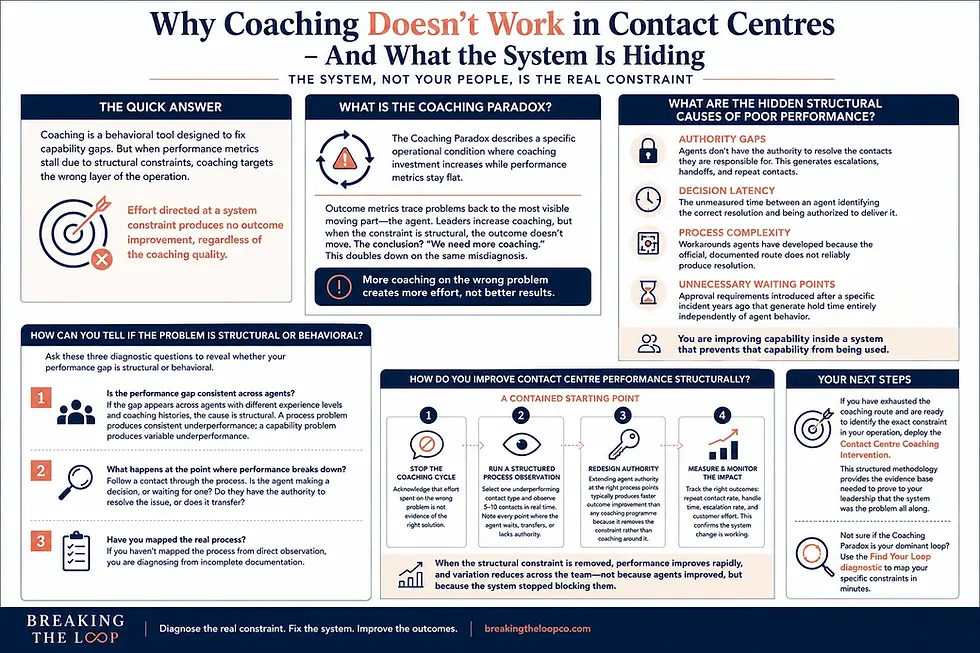
What Is the Coaching Paradox?
The Coaching Paradox describes a specific operational condition where coaching investment increases while performance metrics stay flat.
The paradox develops because outcome metrics—like service levels, handle times, and first contact resolution—measure what happened at the end of the process and trace it back to the person who was there when it went wrong. The agent is the most visible moving part, so every measure looks like a people problem.
Leaders respond rationally to this data by increasing coaching. However, when the constraint is structural, the outcome doesn't move. The conclusion drawn—that the coaching needs to be more rigorous—doubles down on the exact same misdiagnosis. The evidence of coaching effort becomes the false proof of the team's inadequacy.
What Are the Hidden Structural Causes of Poor Performance?
When coaching isn't improving contact centre performance, the cause almost always sits in the actual process your agents navigate on every contact—not the documented process, but the real one.
Common structural causes include:
Authority Gaps:
Agents don't have the authority to resolve the contacts they are responsible for. This generates escalations, handoffs, and repeat contacts.
Decision Latency:
The unmeasured time between an agent identifying the correct resolution and being authorized to deliver it.
Process Complexity:
Workarounds agents have developed because the official, documented route does not reliably produce resolution.
Unnecessary Waiting Points:
Approval requirements introduced after a specific incident years ago that generate hold time entirely independently of agent behavior.
You are improving capability inside a system that prevents that capability from being used.
How Can You Tell if the Problem Is Structural or Behavioral?
Before scheduling the next round of performance conversations, it is vital to stress-test your diagnosis. Ask these three diagnostic questions to reveal whether your performance gap is structural or behavioral:
Is the performance gap consistent across agents?
If the gap appears across agents with different experience levels and coaching histories, the cause is structural. A process problem produces consistent underperformance; a capability problem produces variable underperformance.
What happens at the point where performance breaks down?
Follow a contact through the process. Is the agent making a decision, or waiting for one? Do they have the authority to resolve the issue, or does it transfer?
Have you mapped the real process?
If you haven't mapped the process from direct observation, you are diagnosing from incomplete documentation.
How Do You Improve Contact Centre Performance Structurally?
To improve call center agent performance, you must shift from managing people toward targets, to examining the system that produces the outcomes.
A Contained Starting Point:
Stop the Coaching Cycle:
Acknowledge that effort spent on the wrong problem is not evidence of the right solution.
Run a Structured Process Observation:
Select one underperforming contact type and observe five to ten contacts in real time. Note every point where the agent waits, transfers, or lacks authority.
Redesign Authority:
Extending agent authority at the right process points typically produces faster outcome improvement than any coaching programme because it removes the constraint rather than coaching around it.
When the structural constraint is removed, performance improves rapidly, and variation reduces across the team—not because agents improved, but because the system stopped blocking them.
If you have exhausted the coaching route and are ready to identify the exact constraint in your operation, deploy the Contact Centre Coaching Intervention. This structured methodology provides the evidence base needed to prove to your leadership that the system was the problem all along. Not sure if the Coaching Paradox is your dominant loop? Use the Performance Scorecard Diagnostic to map your specific constraints in minutes.

Comments