What Complaint Volume Really Tells You in a Contact Centre
- Graeme Colville
- Mar 28
- 5 min read
Updated: May 15
Complaint volume is usually treated as a problem.
It goes up, and the response is immediate:
Reduce it
Contain it
Respond faster
But complaint volume is not just something to manage.
It is one of the clearest signals your operation produces.
If you read it properly, it tells you exactly where your system is failing.
For the full structural explanation of how complaint volume connects to CSAT and what the gap between them reveals, see the complete guide to complaints vs CSAT in contact centres.
What Complaint Volume Means in a Contact Centre
Complaint volume in a contact centre reflects the number of times customers raise unresolved issues, escalate dissatisfaction, or formally report a failure in the service they received.
It is not just a count of unhappy customers.
It is a signal that something in the system is not working as intended.
When complaint volume increases, it usually means:
Issues are not being fully resolved
Customers are having to come back
The process is creating friction or delay
Expectations are not being met
Complaint volume is not random.
It is patterned.
Why Complaint Volume Is Often Misunderstood - And What Call Center Quality Assurance Metrics Miss
Most operations treat complaints as noise.
Something to reduce as quickly as possible.
That leads to actions like:
Faster response targets
Tighter escalation handling
More oversight and reporting
None of these address why complaints exist in the first place.
They manage the output.
They do not change the system creating it.
Call center quality assurance metrics follow the same pattern - they measure execution within interactions and improve consistency, but they do not surface the system failures generating complaint volume in the first place.
This is why complaint volume often stays flat or continues to rise, even after improvement efforts.
Complaints Are Signals, Not Failures
A complaint is not the failure.
It is evidence of a failure that has already happened.
That failure usually sits earlier in the customer journey.
For example:
A delay that was not communicated clearly
A process that required multiple contacts
A policy that prevented resolution
A system that could not complete the request
The complaint is the moment the customer decides the experience is no longer acceptable.
If you only focus on the complaint itself, you miss the cause.
Contact center sentiment analysis captures emotional signals at the interaction level - useful for understanding tone, but limited in the same way as CSAT. Complaint volume captures the structural failure that sentiment analysis cannot see: what happened after the interaction ended.
The Different Types of Complaint Signals - Including Escalation Management Failures
Not all complaints mean the same thing.
If you treat them as a single number, you lose the insight.
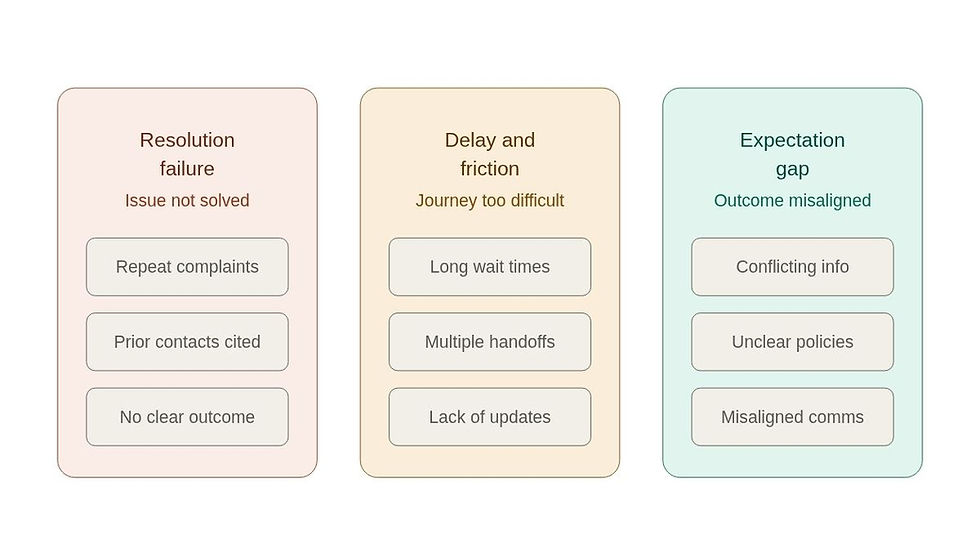
There are usually three types of complaint signals:
1. Resolution Failure Complaints
The issue was not solved.
These often show up as:
Repeat complaints
Customers referencing previous contacts
Ongoing issues with no clear outcome
This is the strongest signal of system failure.
2. Delay and Friction Complaints
The issue might be solvable, but the journey is too difficult.
These complaints often include:
Long wait times
Multiple steps or handoffs
Lack of updates
The problem is not always the outcome.
It is the effort required to get there.
3. Expectation Gap Complaints
The outcome did not match what the customer expected.
These often come from:
Conflicting information
Unclear policies
Misaligned communication
The system may be working as designed.
But the expectation has not been managed properly.
Escalation management failures sit across all three complaint types - a resolution failure that escalates, a friction journey that escalates, an expectation gap that escalates. Customer escalation management that focuses only on the escalation point misses where each of those three failures was created.
Why Low Complaint Volume Can Be Misleading
Low complaint volume is often seen as a success.
It is not always.
Low complaints can mean:
Customers are not bothering to complain
Issues are being abandoned, not resolved
Frustration is showing up elsewhere (churn, repeat calls)
In some operations, complaint volume is artificially low because:
The complaint process is difficult
Customers are redirected or discouraged
Issues are absorbed into general contact volume
That hides the signal.
It does not remove the problem.
How Complaint Volume Connects to Repeat Demand
Complaint volume is closely linked to repeat demand.
When customers have to come back about the same issue:
The likelihood of complaint increases
Frustration compounds over time
Escalation becomes more likely
If you are seeing:
Rising complaint volume
Increasing repeat contacts
You are likely dealing with the same underlying problem.
For the specific pattern of the same complaint recurring across customers, why repeat complaints keep coming back in a contact centre explains the cycle and what breaks it.
The structural conditions that generate repeat complaints are the same conditions that drive repeat demand in contact centres - and removing them reduces both simultaneously.
What Rising Complaint Volume Is Really Telling You
When complaint volume increases, the message is not:
“Customers are more difficult.”
It is usually one of the following:
Resolution capability has decreased
A process has broken or slowed down
A change has introduced friction
Demand has shifted in a way the system cannot handle
This is especially common after:
New system implementations
Policy changes
Process redesigns
Cost reduction initiatives
Complaint volume is often the first visible signal that something has gone wrong.
Why Complaints Increase Even When Performance Improves
This is where it gets confusing.
You improve:
CSAT
Quality scores
Adherence
And complaint volume still rises.
This connects directly to the mechanism explained in why complaints increase while CSAT improves - the system improving at the interaction level while structural failures persist beneath it.
You are improving how interactions are handled.
But not what the system delivers.
How to Use Complaint Volume Properly
Instead of asking “How do we reduce complaints?”
Ask:
What types of complaints are increasing?
Where in the journey do they originate?
Are they repeat issues?
What is preventing resolution?
Then:
Group complaints by root cause
Identify repeat patterns
Prioritise the highest-impact issues
Fix the system, not the symptom
Complaint volume becomes useful when it is connected to cause.
How to Use Complaint Volume to Reduce Complaints in Your Contact Centre
Most operations:
Track complaint volume
Report on trends
Set reduction targets
But do not:
Link complaints to repeat demand
Trace issues back to their source
Fix the underlying system
So the same complaints keep coming back.
The Bottom Line
Complaint volume is not just a metric.
It is a diagnostic tool.
If you treat it as something to reduce, you will manage symptoms.
If you treat it as a signal, it will show you exactly where your operation is failing.
And where to focus your effort.
The escalation management intervention gives you a clear method to turn those signals into action - so you can stop chasing scores and start fixing what is actually driving complaints.


Comments